
Championing service design for virtual healthcare solution
Project type: Service design
My role: Lead Service Designer and Researcher
Additional team members:Service Designer, 3 UX researchers, UX Designer
Stakeholders: Clinical operations lead, Clinic training team, digital enterprise virtual care team, patient-facing virtual care team
Timeline: 12 weeks
Enterprise Virtual Care for CVS planned to launch less than a year away, and the Digital design and research team recognized a gap in our understanding of the service. While many research efforts focused on the patient experience, we lacked any understanding of how providers worked.
A service is designed with multiple actors in mind. Improving the patient experience often requires that the provider experience needs to change as well. This initiative aimed to inform and improve both provider and patient experience as the virtual care platform was finalized.
Overcoming research challenges
The barrier: The primary reason why no one addressed this gap was because everyone recognized observing clinic sessions with in-person and virtual providers was a high lift, especially during the COVID-19 pandemic. Leadership all wanted to ensure safety, follow HIPAA guidelines, and protection of PII.
Approach to solution: I connected with different people across the company in pharmacy and UX who conducted in-person research sessions with medical providers to capture precedence. This was also a rare opportunity to train other researchers in ethnographic methods. To champion and conduct this research I leveraged 1)the urgency around a virtual care launch 2) lack of understanding provider side, which put a good launch at risk 3) the opportunity for other UX researchers to develop their skills. I also outlined the safety risks and precautionary measures for all people involved joining in-person visits.
Finding a champion: I identified a key stakeholder in Clinical Operations who was keenly interested in this topic as well, and she helped to identify which clinics and providers to visit. Having this stakeholder outside of UX research and design was key to addressing this service design challenge.
Identifying segments and questions
Because this initiative was foundational research for all of virtual care, we identified segments of providers and contexts to cover a range of use cases.
- Behavioral health visits, virtual and in-person
Minute Clinic providers - Acute care appointments, virtual and in-person
Virtual only providers
Minute Clinic providers
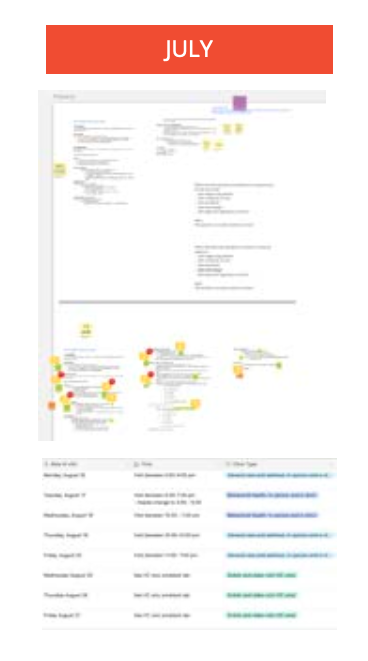
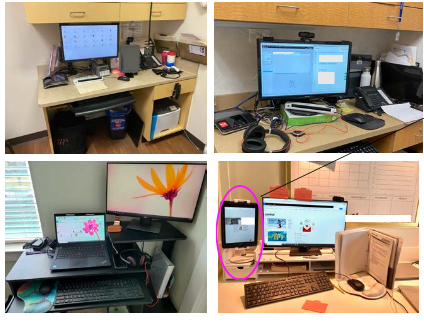
What we listened to: We conducted ten 60-90 minute semi-structured interviews, both in-person and remote. Topics were identified based on secondary research on what is needed to make virtual care visits successful as well as stakeholder guidance. Providers were asked to share screens for certain portions of their workflow.
We were fortunate to observe a range of e-clinic visits to cover behavioral health, acute care, and prescription refill. Prior to these visits, providers asked these patients if they would give permission for another team member to observe.
Observations, insights and bringing others along
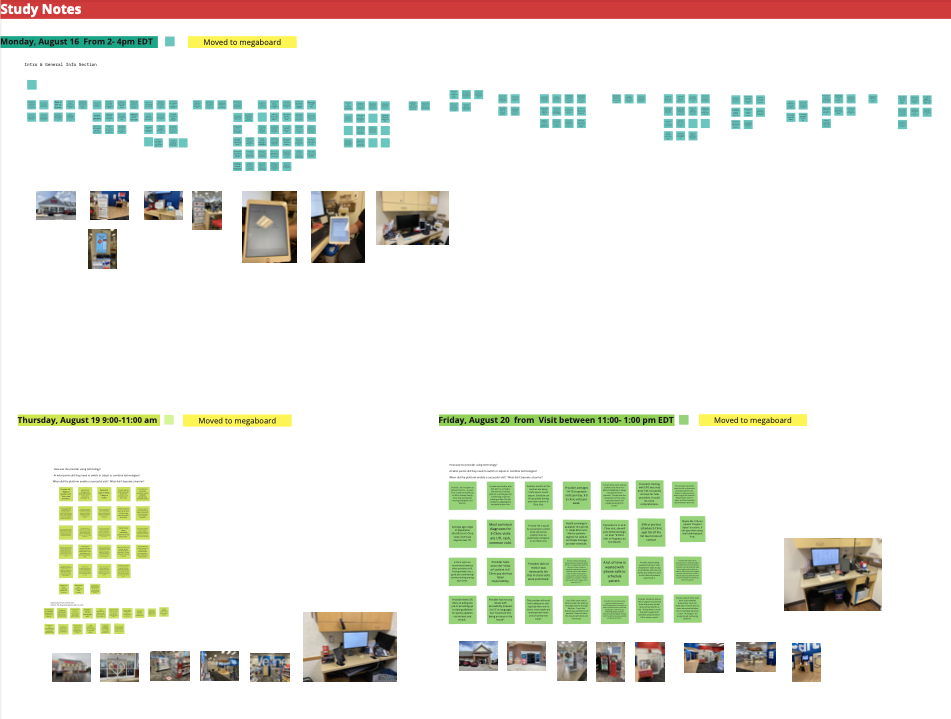
Bringing the team along: Observations and interviews were scheduled across 2 weeks, and overall included 6 researchers, designers and a scrum master who helped take notes and digest learnings from visits.
After each visit or interview, the team held 30 min of time to digest what they heard. Additionally, at the midpoint of our analysis, we shared early learnings with two key stakeholders to gather additional feedback.
Continual sharing with key stakeholders is always a key step for the research process, especially when the stakeholders are outside of your immediate department. This was also the first time this stakeholder worked directly with the digital research team, so we built trust over time.
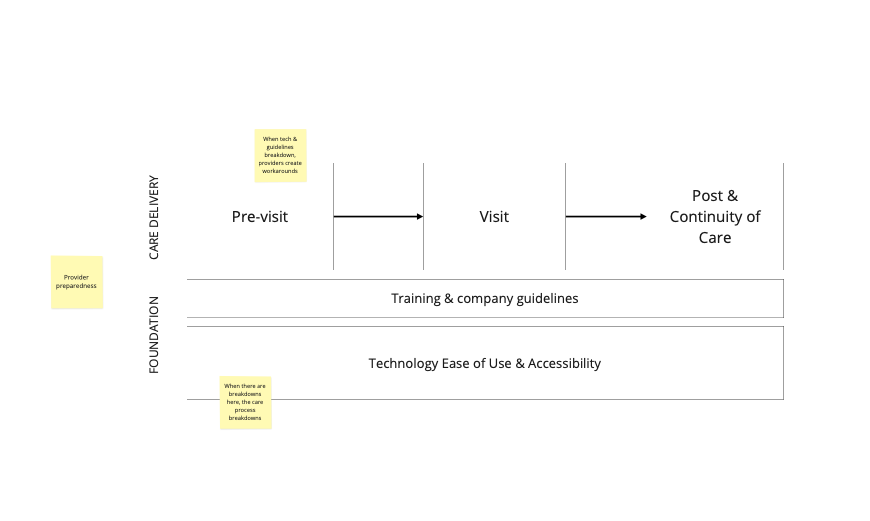
What we learned: Through the synthesis, we identified the technical and training foundations for a successful telehealth visit, that supported the pre, during and post-visit experience.
Several key insights included
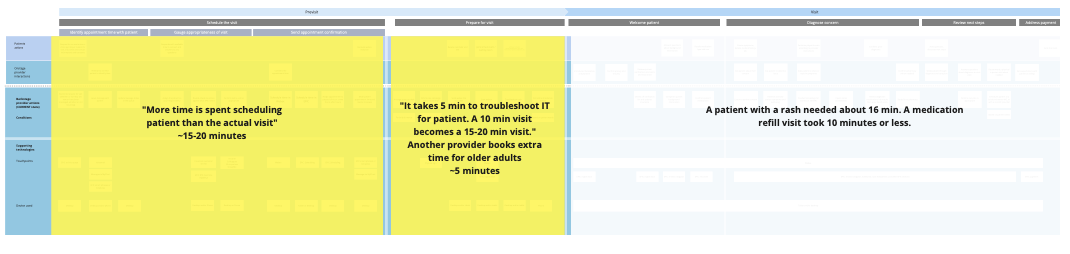
- Both pre-visit time and post-visit time can each take the provider the same amount of time as the visit itself
- Providers believe the telehealth performance measures to be unfair, incentivizing wrong behaviors
- Behavioral health visits need the capability of being linked as continuous sessions, whereas they currently mirrored the acute care, single-case sessions.
Blueprinting & Dissemination
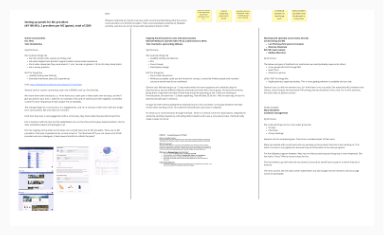
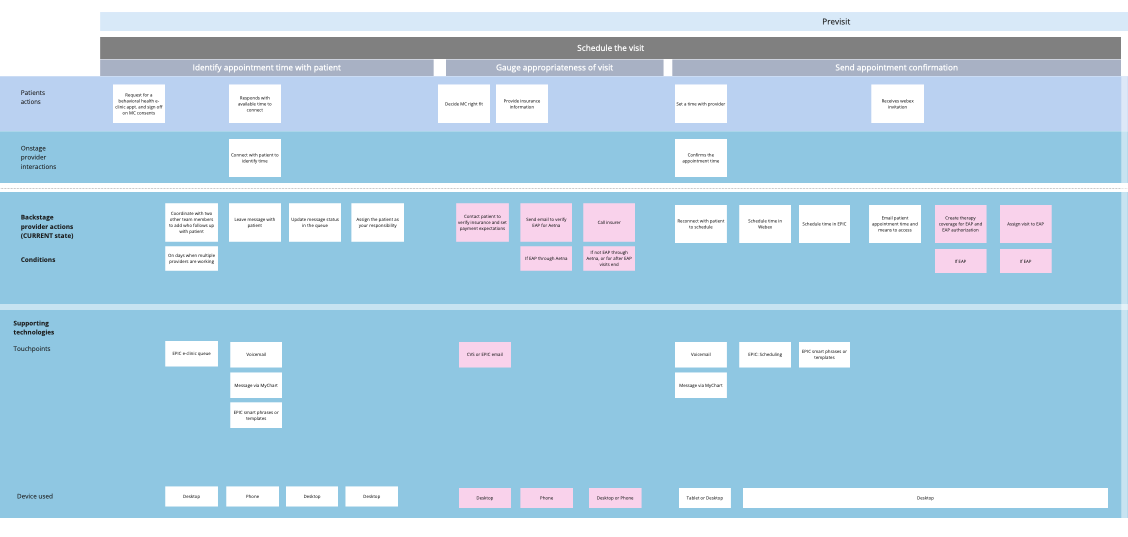
As part of the synthesis, I led the creation of sets of service blueprints to illustrate how provider experiences influenced the end patient experience. These sets were based on key insights learned from the data.
- Current state Behavioral Health visit
- Current state Telehealth and Teladoc visit
- Ideal and achievable acute care e-clinic visit for On Demand
- Ideal and achievable acute care e-clinic visit for Pre-scheduled visit
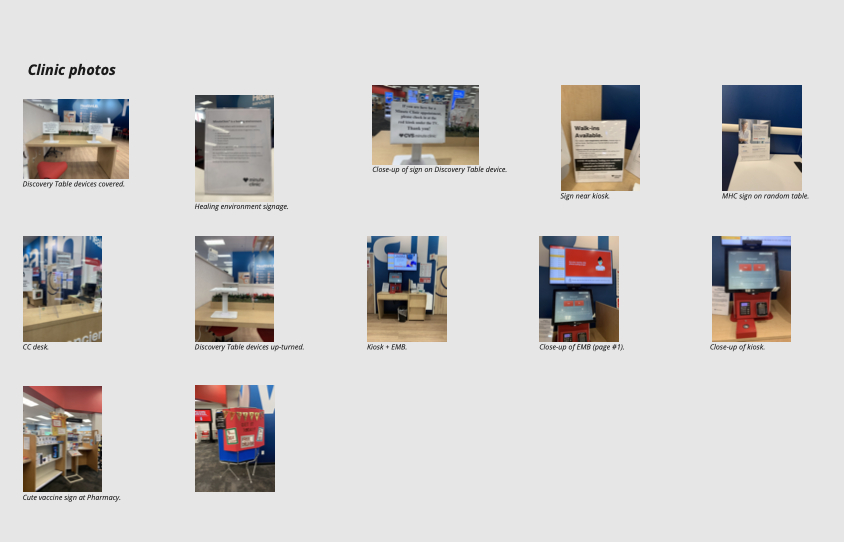
Value of outputs: The blueprints illustrated new features and capabilities to improve provider and patient experience while deprecating current steps. They also demonstrated how pre-visit steps could be reduced by over 50% with behavioral health providers. They accounted for other touchpoints in the service, and recommended updates to the Electronic Message Board in the waiting room to secure PII.
Value to team: As part of the dissemination, we uptrained 2 virtual care designers in service design basics to demonstrate how they could use this holistic view to track and design for technical and legal dependencies while keeping the patient and provider experience in mind.
We also shared the learnings with all the providers who took part in the study, who were not considered immediate stakeholders at the corporate level.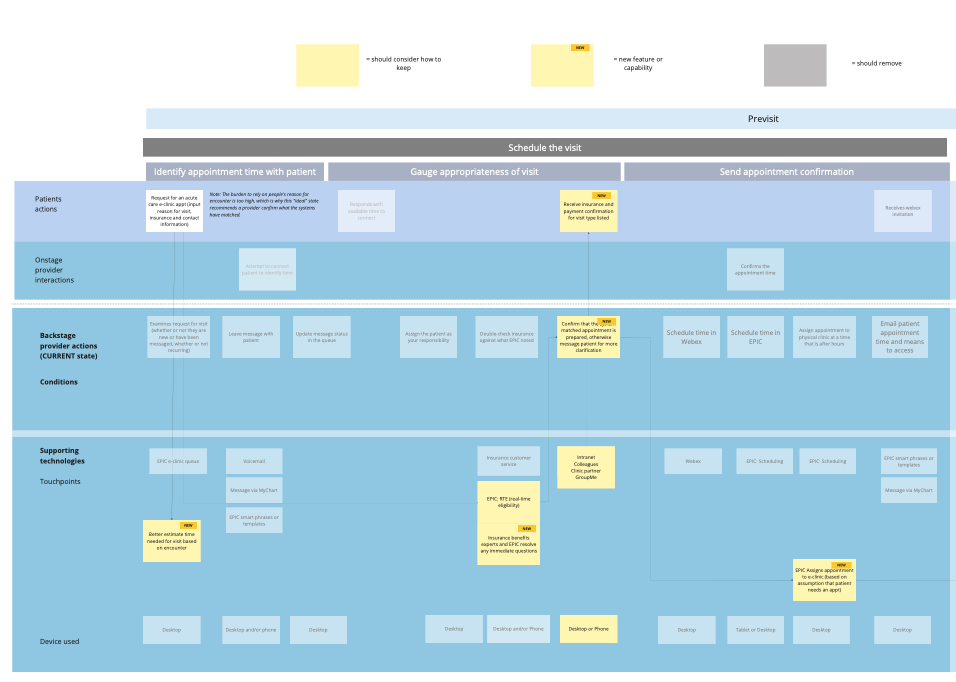
Outcomes
This initiative demonstrated means to reduce behavioral health pre-visit tasks by over 50% by leveraging external insurance checks.
We illustrated new features and capabilities to improve provider and patient experience while deprecating current steps.
We set precedence with Virtual Care design team to conduct in-depth, in-person research sessions with providers and patients
For the digital services team, we uptrained 2 designers in service design basics and guided 6 researchers, designers and scrum master in in-person observations.
OUTPUTS
Recommendations for provider training
Recommendations for technology ease of use & accessibility